Kadri Vihvelin on free will

Suppose determinism is true. This would mean that every decision we make at any given moment follows inevitably from the laws of physics, biology, and chemistry, etc. (from here on laws of nature for short), as well as the entire chain of prior events stretching back to the beginning of the universe. Many of these laws may be neither known nor knowable. According to a widely accepted definition, free will requires the ability to have chosen otherwise. But determinism appears to rule out any possibility of having made a different choice than the one we actually did.

Philosopher Kadri Vihvelin (2004) offers a thought-provoking analysis of how free will might still be possible under determinism, a flavour of compatibilism. This post is a summary of her argument.

Before we begin, why on earth would we even entertain the idea of determinism? At first glance, the existence of randomness seems to challenge it. However, what appears random may emerge from combinations of an unimaginably vast number of deterministic causes. Pseudorandom number generators, for example, are relatively simple algorithms which produce sequences that appear random but are entirely deterministic. Algorithms are small. The universe is big. “You just won’t believe how vastly, hugely, mind-bogglingly big it is,” said Douglas Adams. The universe could be a really complicated pseudorandom generator.

Quantum mechanics also seems to challenge determinism. When measuring a quantum particle (like a photon) in superposition, the outcome follows a probability distribution (I previously tried to explain this with a toy example). This indeterminacy has led many to interpret quantum mechanics as fundamentally probabilistic. Yet some physicists defend superdeterminism, an apparently controversial idea suggesting that even quantum measurements are predetermined, including the choices physicists make when selecting measurement settings in experiments (Hossenfelder & Palmer, 2020).

That’s just a sketch; however, hopefully enough to suggest that determinism isn’t too absurd to read on.

Choosing means, more specifically, making choices on the basis of reasons. Libet and others have conducted numerous studies on the neuroscience of choosing, which may challenge the role of conscious choice (see Haggard, 2024, for discussion). However, we are more than what we are conscious of. For example, we retrieve memories without knowing how our brains searched for them, and we move through the world without being aware of how our nervous system coordinates muscle movements. I’m happy to accept a choice as mine, even if a bunch of subconscious processes did the choosing, so long as it was made on the basis of reasons – even ones I’m unaware of.

At the heart of Vihvelin’s position is the idea that our choices stem from bundles of dispositions (tendencies, causal powers, or capacities) much like the ability to speak French, drive, dance, or sing. Crucially, dispositions don’t disappear simply because we haven’t exercised them. If we chose to run at a particular moment, that doesn’t mean we lacked the disposition to walk, crawl, skip, or dance. Likewise, if we spoke French at some point, it doesn’t follow that we couldn’t have spoken English (assuming we know both languages). Or consider something simpler: a working sprinkler system. It has the dispositions required to flood a room – detecting heat or smoke (reasons) and releasing water (making a choice) – even if it never activates during its lifetime.
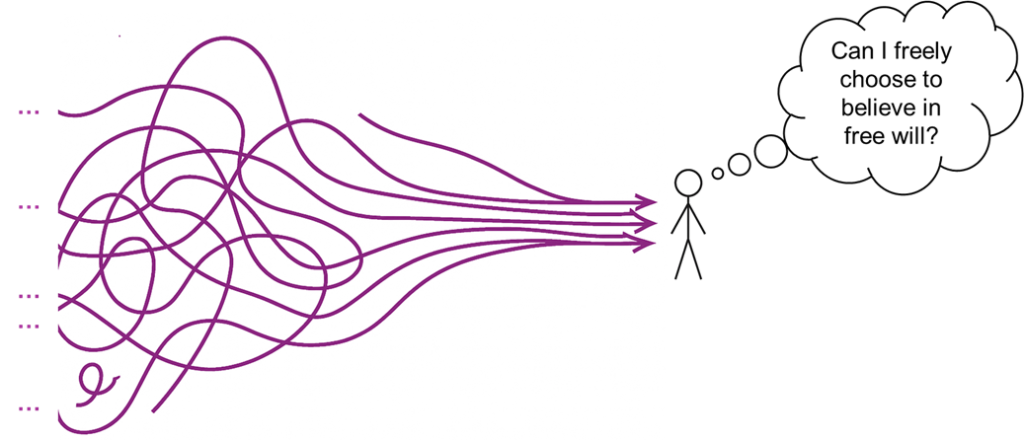
Free will, according to Vihvelin’s compatibilist account, is the ability to make choices on the basis of reasons and to have this ability is to have a bundle of dispositions. She offers the following menu of dispositions that are likely needed (p. 439):

“[T]he disposition to form and revise beliefs in response to evidence and argument; the disposition to form intentions (choose, try to act) in response to her desires […] and beliefs about how to achieve those desires; the disposition to engage in practical reasoning in response to her intention to make a rational (defensible, justifiable) decision about what to do and her belief that by engaging in practical reasoning she will succeed in making such a decision.”

So, given determinism (laws of nature, history of the universe) and a choice we made, we had a bundle of dispositions that would have enabled us to choose otherwise – free will.

Vihvelin spells out the argument as follows (p. 432):

  1. Dispositions are compatible with determinism.
  2. Abilities are dispositions or bundles of dispositions.
  3. Therefore, the existence of abilities is compatible with determinism.
  4. Free will is the ability to choose on the basis of reasons (I’d add, including subconscious reasons and choosing), and we have this ability by having a bundle of dispositions.
  5. Therefore, free will (the ability to choose on the basis of reasons) is compatible with determinism.
  6. Abilities (like other dispositions) typically continue to exist even when they are not being exercised or manifested.
  7. Therefore, determinism is compatible with the existence of unexercised abilities, including the ability to choose on the basis of reasons.
  8. Abilities are like dispositions with respect to the entailment from the claim that a person has the ability (disposition) to do X to the claim that the person can do X.
  9. Therefore, determinism is compatible with the truth of the claim that persons can choose and do other than what they actually choose and do.

I think that this argument also relates to what Holland (1986, p. 947) called the fundamental problem of causal inference. When evaluating a social programme, we observe the outcomes (like mental health or education) of those who take part, but we can’t observe what someone’s outcome would have been without the programme: the counterfactual outcome. We can infer their counterfactual outcomes (on average) from a well-constructed comparison group, or we can make a reasoned argument based on a theory of what they might have been able to do without the programme, including a theory of their bundles of dispositions.

It’s a similar issue with free will. When someone chooses to do something at some point in time, we can’t observe what their outcome would have been had they chosen to do differently. But, according to Vihvelin’s analysis, if they had free will, they had a bundle of dispositions that would have enabled them to choose otherwise. We can infer how they could have chosen, perhaps by finding people like them who did choose differently, or by making a counterfactual argument on the basis of what their bundle of dispositions are.

Thank you Joanna and the Philosophy Circle at NLC (14 November 2025) for helpful discussion!

References

Haggard, P. (2024). An intellectual history of the ‘Libet experiment’: Embedding the neuroscience of free will. Proceedings of the Paris Institute for Advanced Study, 1.

Holland, P. W. (1986). Statistics and causal inference. Journal of the American Statistical Association, 81(396), 945–960.

Hossenfelder, S., & Palmer, T. (2020). Rethinking Superdeterminism. Frontiers in Physics, 8, 139.

Vihvelin, K. (2004). Free Will Demystified: A Dispositional Account. Philosophical Topics, 32, 427–450.

Is there any point in therapy if behaviour is “unavoidably determined”?

In an introduction to psychodynamic ideas, Jonathan Shedler (2022, p. 432) claims:

“If behavior were unavoidably determined, there would be no reason to practice psychoanalytic therapy or, for that matter, any form of therapy.”

Although I’m not sure about determinism, I think this assertion is false. I also believe it is important to understand why it is false for clients who do believe in determinism, such as the occasional philosopher.

Suppose behaviour were unavoidably determined. We still experience stuff, some of it fun, some of it not. Our accompanying conscientious sensations that go along for the ride doesn’t seem to care. Related to this, I think it’s interesting that we still go to the cinema and read books even though we know the ending has already been decided: we seem to derive great pleasure from finding out what happens next. “You should go on living, if only to satisfy your curiosity”, goes the Yiddish proverb.

Importantly for therapy, chatting with someone and feeling listened to partially determines what we do and how we feel. While it’s possible that therapy is merely another link in the massive causal network of the universe, it is hopefully more likely to improve someone’s life than other links, regardless of how predetermined going to see the therapist and its consequences might be. As Galen Strawson puts it (2010, p. 247, footnote 22):

“Naive fatalism holds that there is no point in doing anything because everything is predetermined […], hence nothing you can do can change how things will be. It is false, because one’s doings and deliberations can change things, being themselves real parts of the (possibly deterministic) causal process.”

References

Shedler, J. (2022). That Was Then, This Is Now: Psychoanalytic Psychotherapy For The Rest Of Us. Contemporary Psychoanalysis, 58, 405–437.

Strawson, G. (2010). Freedom and Belief, Revised Edition.

Superdeterminism

Bell (1981, C2-57):

“… it may be that it is not permissible to regard the experimental settings a and b in the analyzers as independent variables, as we did. We supposed them in particular to be independent of the supplementary [a.k.a. hidden] variables λ, in that a and b could be changed without changing the probability distribution ρ(λ). Now even if we have arranged that a and b are generated by apparently random radioactive devices, housed in separate boxes and thickly shielded, or by Swiss national lottery machines, or by elaborate computer programmes, or by apparently free willed experimental physicists, or by some combination of all of these, we cannot be sure that a and b are not significantly influenced by the same factors λ that influence A and B [measurement outcomes]. But this way of arranging quantum mechanical correlations would be even more mind boggling that one in which causal chains go faster than light. Apparently separate parts of the world would be deeply and conspiratorially entangled, and our apparent free will would be entangled with them.”

Hance and Hossenfelder (2022, p. 1382) on the assumption of statistical independence of supplementary/hidden variables and experimental settings:

“Types of hidden variables theories which violate statistical independence include those which are superdeterministic, retrocausal, and supermeasured. Some have dismissed them on metaphysical grounds, by associating a violation of statistical independence with the existence of ‘free will’ or ‘free choice’ and then arguing that these are not assumptions we should give up.

“It is, in hindsight, difficult to understand how this association came about. We believe it originated in the idea that a correlation between the hidden variables and the measurement setting would somehow prevent the experimentalist from choosing the setting to their liking. However, this is mistaking a correlation with a causation. And any serious philosophical discussion of free will acknowledges that human agency is of course constrained by the laws of nature anyway.”

References

Bell, J. S. (1981). Bertlmann’s socks and the nature of realityLe Journal de Physique Colloques42(C2), C2-41-C2-62. Reprinted in Bell (2004).

Bell, J. S. (2004). Speakable and unspeakable in quantum mechanics: Collected papers on quantum philosophy (2nd ed.). Cambridge University Press.

Hance, J. R., & Hossenfelder, S. (2022). Bell’s theorem allows local theories of quantum mechanics. Nature Physics, 18(12), 1382.  [Preprint]


Appeal to consequences fallacy in understanding Bell’s theorem

Joan Vaccaro (2018, p. 11) on arguments against superdeterminism:

“An argument that has been advocated by leading physicists is that humans are necessarily independent of the universe that surrounds them because the practice of science requires the independence of the experimenter from the subject of study. For example, Bell et al. state that unless the experimenter and subject are independent, we would need to abandon ‘…the whole enterprise of discovering the laws of nature by experimentation’, and Zeilinger claims that if the experimenter and subject were not independent ‘…such a position would completely pull the rug out from underneath science.’ However, this argument contains a logical fallacy called an appeal to consequences. Specifically, arguing for experimenter–subject independence on the basis that the alternative has undesirable consequences does not prove that experimenters are independent of their subjects. Rather, the alternative may well be true, in which case we would need to deal with the consequences.”

References

Vaccaro, J. A. (2018). The quantum theory of time, the block universe, and human experience. Philosophical Transactions of the Royal Society A: Mathematical, Physical and Engineering Sciences, 376(2123).

An attempt to diagram the tension between determinism and belief in causa sui

My understanding of the story so far, following lengthy and ongoing discussions with I, L, P and others (see also the free will tag on this site, stretching back to 2007):

  1. Nothing can be a cause of itself, causa sui.
  2. To be truly, really, wholly responsible for your actions, you would have to be causa sui (the self-determination thesis).
  3. Your choices depend on who you are (e.g., your personality, values, beliefs, desires, powers) and where and when you are (linked to your opportunities). Who, where, and when in turn depend on billions of complex causal chains that precede your existence and stretch back to the beginning of time.
  4. Therefore, you are not truly, really, wholly responsible for your actions.
  5. However, you can still change: your personality, values, beliefs, powers, etc. – your nature is not fixed. You clearly don’t stay still in time or space either.
  6. You can also carry out actions and have an effect on the world as an active participant in cause-effect chains.
  7. Moreover, praise and blame and other common attributions people bestow upon one another, though difficult to comprehend in light of conclusion 4 above, are example causes of actions since they have an effect on people.

Here is an attempt to diagram the above, assuming that determinism holds (though that need not be the case for the self-determinism thesis to fail). Instead of a complex web of billions of cause-effect chains stretching back to the beginning of time, I have embodied that long history all in a cat that has a grand unplan (I’m not sure how the conversation arrived there), borrowed from the interweb.

The arrows above are intended to be wholly determining and not the statistical associations common in social science that explain 5% of the variance in outcomes. All the variance is explained here: 100%.

Below is the cat, viewing the outcomes. Determinism does not imply that it is possible to predict outcomes from starting states. Prediction is tricky even for simple cellular automata let alone something as messy as a universe. You have to “wait” (actively, moving) and see what happens and enjoy the phenomenology that goes along for the ride, including the intense illusion of causa sui. (“You should go on living – if only to satisfy your curiosity” – from a Yiddish proverb, which can also have a causal effect on its readers under determinism.) Unpredictability does not challenge the impossibility of causa sui, though.

Nietzsche on causa sui

‘The causa sui is the best self-contradiction that has yet been conceived, it is a sort of logical violation and unnaturalness; but the extravagant pride of man has managed to entangle itself profoundly and frightfully with this very folly. The desire for “freedom of will” in the superlative, metaphysical sense, such as still holds sway, unfortunately, in the minds of the half-educated, the desire to bear the entire and ultimate responsibility for one’s actions oneself, and to absolve God, the world, ancestors, chance, and society therefrom, involves nothing less than to be precisely this causa sui, and, with more than Munchausen daring, to pull oneself up into existence by the hair, out of the slough of nothingness.’
– Friedrich Nietzsche (written 1886), Beyond Good and Evil, translated from German by Helen Zimmern

Doings and deliberations can change things

“Naive fatalism holds that there is no point in doing anything because everything is predetermined (or is the will of God, for example), hence nothing you can do can change how things will be. It is false, because one’s doings and deliberations can change things, being themselves real parts of the (possibly deterministic) causal process.”
– Strawson (2010, p. 247, footnote 22) [Freedom and Belief, Revised Edition.]

Freedom under determinism

“Behind the whole compatibilist enterprise lies the valid and important insight that, from one centrally important point of view, freedom is nothing more than a matter of being able to do what one wants or chooses or decides or thinks right or best to do, given one’s character, desires, values, beliefs (moral or otherwise), circumstances, and so on. Generally speaking, we have this freedom. Determinism does not affect it at all, and it has nothing whatever to do with any supposed sort of ultimate self-determination, or any particular power to determine what one’s character, desires, and so on will be.”
– Strawson (2010, p. 94) [Freedom and Belief, Revised Edition.]

The Basic Argument

“There is an argument, which I will call the Basic Argument, which appears to prove that we cannot be truly or ultimately morally responsible for our actions. According to the Basic Argument, it makes no difference whether determinism is true or false. We cannot be truly or ultimately morally responsible for our actions in either case.

“The Basic Argument has various expressions in the literature of free will, and its central idea can be quickly conveyed. (1) Nothing can be causa sui – nothing can be the cause of itself. (2) In order to be truly morally responsible for one’s actions one would have to be causa sui, at least in certain crucial mental respects. (3) Therefore nothing can be truly morally responsible.”

– Strawson, G. (1994, p. 5) [The impossibility of moral responsibility. Philosophical Studies: An International Journal for Philosophy in the Analytic Tradition75, 5-24.]